

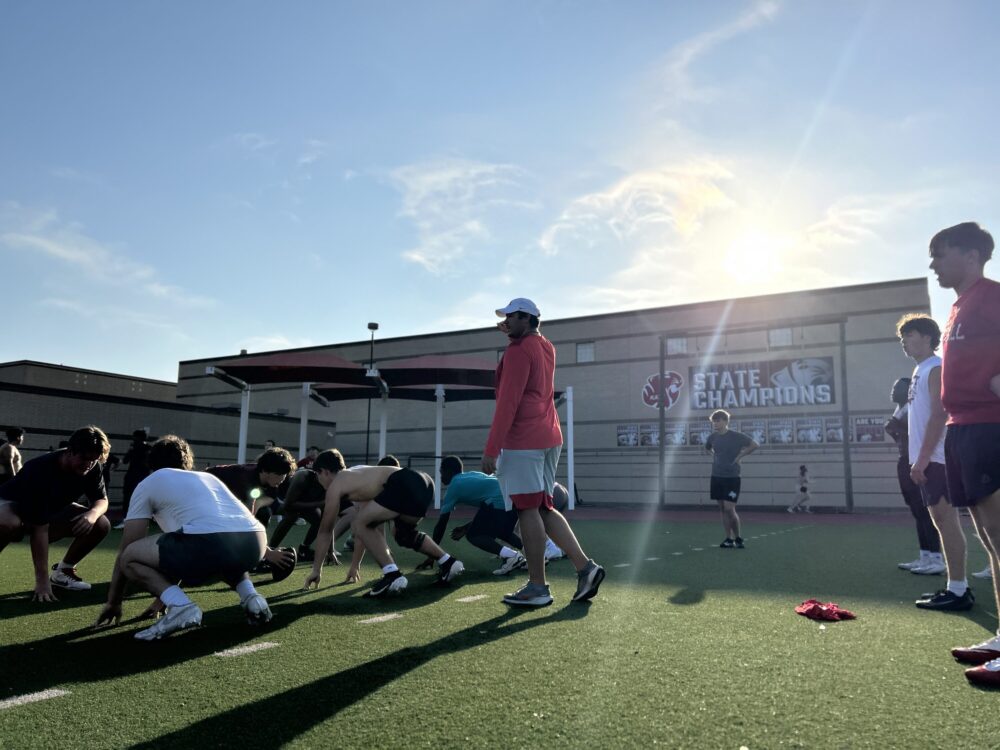
On Monday morning, high school athletes across the greater Houston area laced up their cleats, fastened their helmets, filled their water bottles and geared up for the first week of football practice. After a long summer vacation, they were instantly reminded of the muggy and hot August workouts awaiting them.
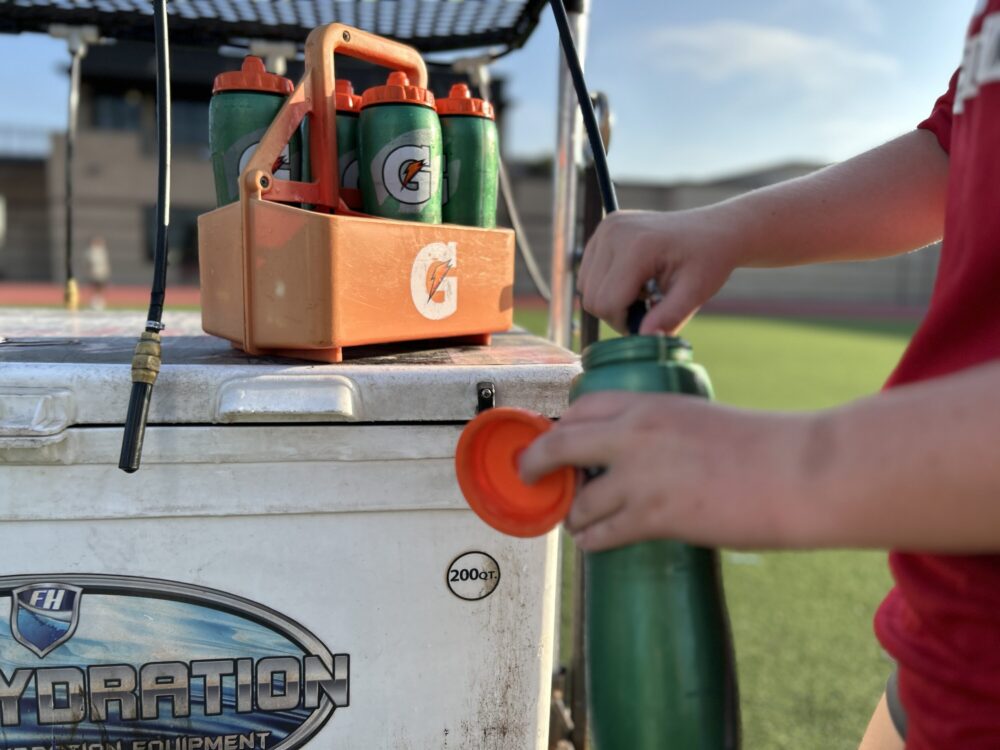
"Line up and get yourself a sip of water before we go again," Joe Longacre, one of the Katy High School football coaches, told players during Monday morning's practice.
This year, the statewide governing body for allathletic, musical and academic school contests,the University Interscholastic League (UIL), has a new requirement for outdoor practices that aims to keep students safe in the Texas heat. Starting Saturday, teams in all sports are now required to measure the wet bulb globe temperature – WBGT – before practicing outside. And depending on the reading, they could be forced to take a certain number of breaks, cut their workouts short or, if it's hot enough, scrap them altogether.
The readings take into account air temperature, humidity, wind speed and cloud cover to develop a measure of overall heat stress. Although WBGT is also measured in degrees, the scales don't directly translate to Fahrenheit temperatures.
The measure is more informative than other heat readings, like heat index, for calculating how much time is safe to spend outdoors.
"Heat index is only factoring air temperature and humidity and it's assuming you are in the shade," said Jimmy Fowler, a meteorologist for the National Weather Service's Houston/Galveston office.
In most parts of the state, the newWBGT rulemeans for teams to practice outdoors for the full three-hour allowance with no modifications permitted by the UIL, the reading has to be under 82. Anything higher than that mandates at least three 4-minute breaks per hour and an on-site rapid cooling site like an ice bath in case an athlete experiences heat illness or distress.
Above 87, an outdoor practice must be limited to two hours, at least four rest breaks per hour are required and football players must wear shorts. If the gauge passes 90, the team is down to an hour of outdoor practice, football players can't wear their pads and helmets, and conditioning drills are out of the question. If it creeps up to 92.1 or higher, practice is moved inside or canceled altogether.
At Monday's early morning practice in Katy, the WBGT clocked in at 86.2. Katy ISD Athletics Executive Director Lance Carter was prepared with several rapid cooling options just steps from the Tigers' practice field.
That included a "taco," which Carter described as a tarp on the sidelines opened like a taco where an athlete can lay down in the middle and get doused in ice water.
After three years of recommending the practice of regulating workouts based on WBGT readings, the UIL board voted to adopt the policy proposal as a requirement in June. Last summer, a high school football player from the Houston areasuffered heatstroke during a private training sessionoutdoors, and a Dallas-area playerdied after a medical emergencyduring an August practice.
Jamey Harrison, the executive director of the UIL, acknowledged there may be some adjustments for schools or districts that had not yet implemented WBGT guidance.
RELATED: ‘It's like a sweatbox': Houston bus stops reach dangerous temperatures
There is also some reported concern from coaches that the readings are too restrictive.TheHouston Chroniclesurveyed local high school football coaches and nearly 80% reported the WBGT requirement is too restrictive.
"The bottom line is, this is the national gold standard for keeping kids safe when working in the heat, and that’s our ultimate goal," Harrison said. "That will require some schools to get out of their comfort zone and do things a little differently than they have in the past, but it is not an insurmountable task by any stretch."
Because Texas spans more than 260,000 square miles with several distinct climate zones, WBGT reading recommendations will also differ based on geography. Most of the state falls under Class 3, with one notable exception: West Texas and the Panhandle, which have more arid climates. Those areas fall under Class 2, where modifications are triggered at lower readings.
The WBGT average for the Houston area in August is between 85 and 95, according to the National Weather Service. This means most outdoor practices early in the season may have some sort of heat-related modification.
"We’re not saying schools can’t practice. That’s not it," Harrison said. "We’re not talking about whole scale days being off limits for people to practice. We’re largely talking about a 2- to 3-hour window on some days. Just don’t put your kids out there in full pads with no restrictions from 4-5:30, 6 [p.m.].
A growing movement
Texas joins at least 17 other U.S. states requiring that WBGT readings guide outdoor practices.
"The proposal also reflects the increasing frequency and severity of extreme heat across the state, particularly during the start of fall sports seasons," Joel Nolte, the UIL's director of compliance services, told the agency's board before its vote. "Establishing mandatory standards provides schools, coaches and administrators with clear direction and reinforces the importance of proactive risk management for student participants."
The WBGT meters themselves are relatively inexpensive devices, but districts are also not required to buy them. The UIL suggests districts without a WBGT gauge can go online and source the measurements from their recommendedWBGT forecasting site.
Following the guidelines is required only for practices and not for competitions, including football games and track meets. Harrison said there are separate recommended best practices for modifying games in high temps.
"Practice and games are very, very different," Harrison said. "One hundred percent of the heat-related deaths that have occurred over the last many years have occurred in practice, none in games, and there’s a reason for that – practices involve long periods of time, lots of high exertional energy, lots of reps. In a standard high school football game [an athlete] is only engaged in 6 to 8 minutes of high exertional activity from start to finish of the game. There’s a lot of downtime in football games."
Andre Walker, the executive athletics director for Houston ISD (HISD), oversees as many as 30,000 student-athletes each school year in the state's largest district. Walker said the district began implementing the WBGT reading guidance three years before the recommendation. HISD's policy also mandates that a WBGT reading in one area will trigger modifications to practices across the district, even if the concerning reading is isolated to one area.
"We’re going to do it across the board because we know and we see how the weather moves," Walker said.
Perry Weathertracked WBGT readings for the eight regions of the Texas High School Athletic Directors Association last year. It reported the Houston region had eight days hit the benchmark for no outdoor workouts, 13 garnered a one-hour practice limit, and 23 fell in the range for a maximum two-hour practice. Most of the concerning readings were concentrated between the hours of 11 a.m. and 5 p.m.
Walker said every HISD campus is equipped – in some form – to move a practice indoors if required.
"Because it takes a gym, it can take a hallway. It doesn’t take much to do the necessary things you need to do to get prepared," Walker said. "It can take an auditorium. It can take – more film study."
Measures for modern times
After nearly 20 years as an athletic trainer in the NBA for the Utah Jazz and Dallas Mavericks, Brian Zettler is now the head athletic director in Comal ISD north of San Antonio. He's also the chairman of the board for the Texas State Athletic Trainers Association.
In the late 1980s, he played football, baseball, basketball and ran track as a student-athlete in Waxahachie, south of Dallas. Looking back, Zettler said the resources, expectations and overall approach to protecting student-athletes have changed dramatically.
"Oh my gosh, you can’t compare the two. I mean, it’s not even apples and oranges," Zettler said. "The way [safer practices] evolved over such a short amount of time was phenomenal, and for the benefit of the student-athlete."
He credits the evolution of the athletic training profession as the biggest difference. Athletic trainers are professionals trained to prevent and treat injuries, and to be accredited in Texas, they are required to complete 1,800 hours of clinic experience, complete a program for licensure, pass a written and practical exam and complete continuing education every two years over the course of their careers.
Zettler said in his role as a head athletic trainer in Comal ISD, he has caught an athlete approaching heat stroke before the student knew it himself.
"He said, ‘Oh no, I'm good, I'm good,' but then he started stammering a little bit and started stuttering," Zettler said.
There is no UIL requirement, however, for campuses to employ an athletic trainer. Zettler said they are commonly found in high schools that compete at the UIL's Class 3A level or above, which generally have at least 250 students.
Texas' smaller high schools, many of which are located in rural areas, often rely on relationships with local hospitals to assess and care for student-athletes if they do not have an athletic trainer on staff.
"In some of these smaller schools it’s just a funding issue," Zettler. "It would be great to have it mandated to have an athletic trainer in every school, but to have an unfunded mandate that’s, you know, not supported by state funds, that would just kind of be dead on arrival."
Katy High School competes in Class 6A, a UIL classification measured by at least 2,215 enrolled students. The Tigers had multiple athletic trainers monitoring Monday's practice, both for traditional injuries and those related to the heat.
Copyright 2026 Houston Public Media News 88.7


